Is work spilling into your life more than it should
This question isn’t really about time management, or resilience, or whether you’re organised enough. It’s not about whether you care too much, or whether others seem to cope better than you do. It’s about something quieter and harder to pin down: the way work can start to follow you home, not in your diary but in your head, and how normal that can begin to feel without you ever deciding it should.
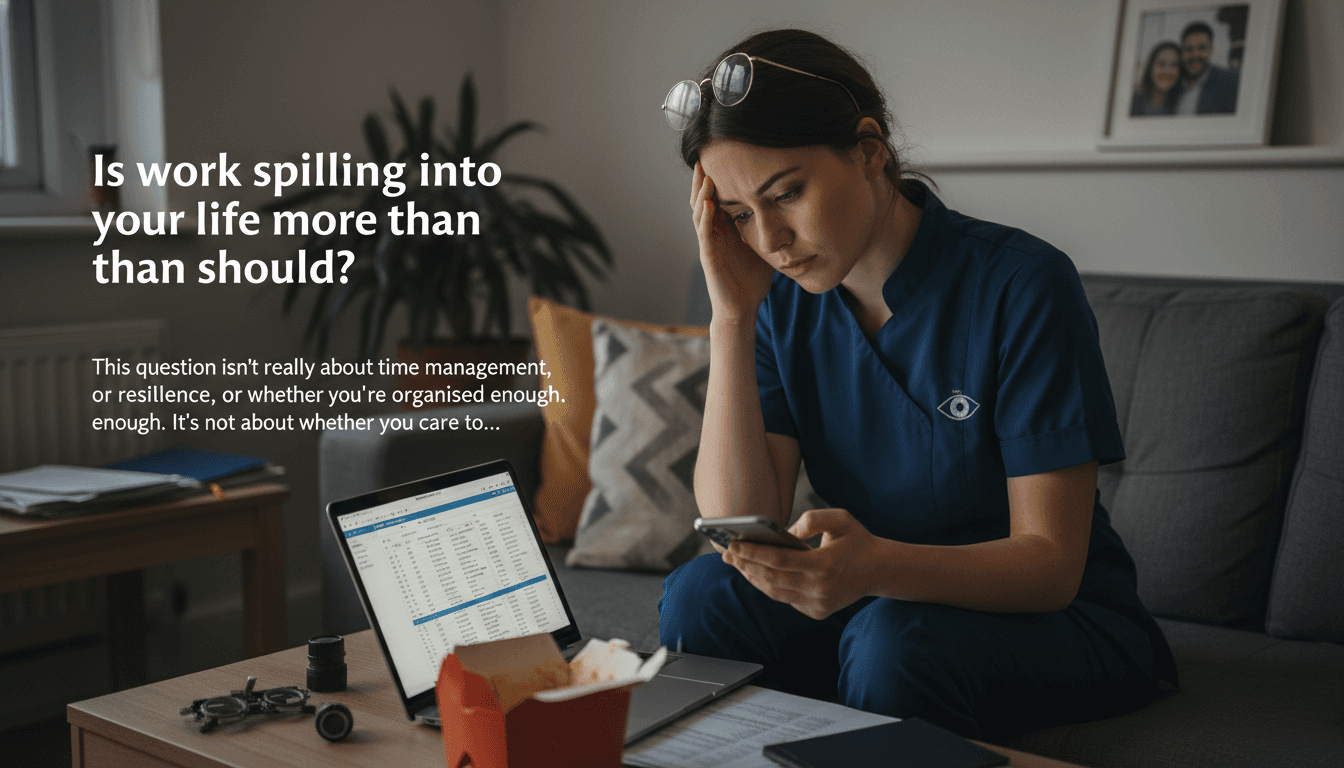
In an optician’s practice, the boundary between work and life has always been thin. You don’t just clock in and process transactions. You hold people’s worries about their sight, their driving, their work, their independence. You try to do that while the clinic is running late, the diary is full, the phone is ringing, and someone at the front desk is dealing with a conversation that’s already gone tense. When you finally leave, the day doesn’t always stay behind. A comment replays. A decision nags. A patient you wish you’d had more time for pops back into your mind when you’re supposed to be switching off.
Most people reading this will recognise that feeling, and it’s worth saying plainly that it doesn’t make you weak or bad at your job. Caring about doing things properly is part of what brought you into this work in the first place. The problem isn’t that work matters to you. It’s what happens when it starts to matter everywhere, all the time, without any space left that’s genuinely yours.
It might be worth asking yourself what “spilling into your life” actually looks like for you, because it rarely arrives as one big obvious thing. Is it the way you’re still thinking about the clinic when you’re cooking dinner, replaying a late afternoon consultation that didn’t quite sit right? Is it checking tomorrow’s diary before bed and feeling your shoulders tighten at the sight of a fully booked clinic with no gaps? Or is it that uneasy sense on your day off that you should be doing something, catching up, staying ahead, even when no one has asked you to?
Another question worth sitting with is when this started to feel normal. Was there a point when staying late, skipping breaks, or taking work home felt like a temporary response to pressure, and then quietly became the baseline? In practice, that shift can happen during a run of overrunning clinics, or a period when targets are hovering in the background and no one quite says it out loud. Over time, the exceptional becomes routine, and the routine becomes invisible.
You might also ask yourself who you are when you’re not at work, and whether that version of you has been getting less airtime. When work is busy and emotionally demanding, it can start to take up not just hours but identity. If someone asked you what you enjoy outside the practice, would the answer come easily, or would there be a pause while you mentally check your rota and responsibilities first?
And then there’s the question people often avoid because it feels uncomfortable. What are you afraid might happen if you didn’t let work spill over as much as it does now? Is there a worry that standards would slip, that patients would lose out, or that you’d be seen as less committed? In an environment where care and commercial reality sit side by side, those fears don’t come from nowhere.
There’s a moment that happens in many practices, often late in the day, when a patient raises a concern just as you’re already running behind. You feel the pull to give them everything they need, and the pressure of the next appointment waiting. How you handle that moment says a lot about your values, but it also shows how easily work can stretch beyond its edges if it’s allowed to. Not because you’re careless with yourself, but because you’re conscientious.
If you wanted to take a step forward, even a small one, it doesn’t have to start with drastic changes or grand declarations. It might begin with noticing which parts of work deserve to follow you home, and which parts don’t. When you think about the things that linger in your mind after hours, are they actually within your control, or are they just familiar worries you’ve grown used to carrying?
You could also wonder what a good day looks like now, compared to a few years ago. Has your definition quietly shifted so that “manageable” has become “just about survived”? If so, what would it mean to reset that bar slightly, in a way that still respects the realities of practice life?
Another angle is to think about the signals you send, often without meaning to. When clinics run late and you absorb the impact silently, or when you answer messages outside work without being asked, what story does that tell others about what’s expected? More importantly, what story does it tell you about what you owe the job?
Finally, it might help to ask where you could create a small, real boundary that fits inside a working day rather than fighting against it. Is there a transition moment, perhaps the walk to the car after a long clinic, where you could consciously leave one specific worry behind? Not all of them. Just one.
None of this is about caring less or doing less. It’s about noticing where the line has drifted, and whether it still serves you as well as it once did. Work will always ask for a lot in this profession. The question is how much of yourself you want to give without realising you’re doing it.
If this has struck a chord, and you want to talk it through in a way that’s grounded in real practice life rather than theory, you’re welcome to reply. Sometimes it helps just to say these things out loud to someone who understands the context.
Where this could take you
Curious what the market looks like for you?
Build your perfect job in under two minutes - postcode in, salary bands, advertised and hidden-market vacancies out.
Build your perfect job