Have you normalised stress that should not be normal
At first glance, this question can sound like a personal failing. As if it’s asking why you haven’t coped better, or why you’ve let something slip. But that isn’t what it’s really getting at. It’s not about resilience, or toughness, or whether you’re cut out for the work. It’s about how easily a certain level of strain can become the background noise of an optician’s day, so familiar that it barely registers anymore.
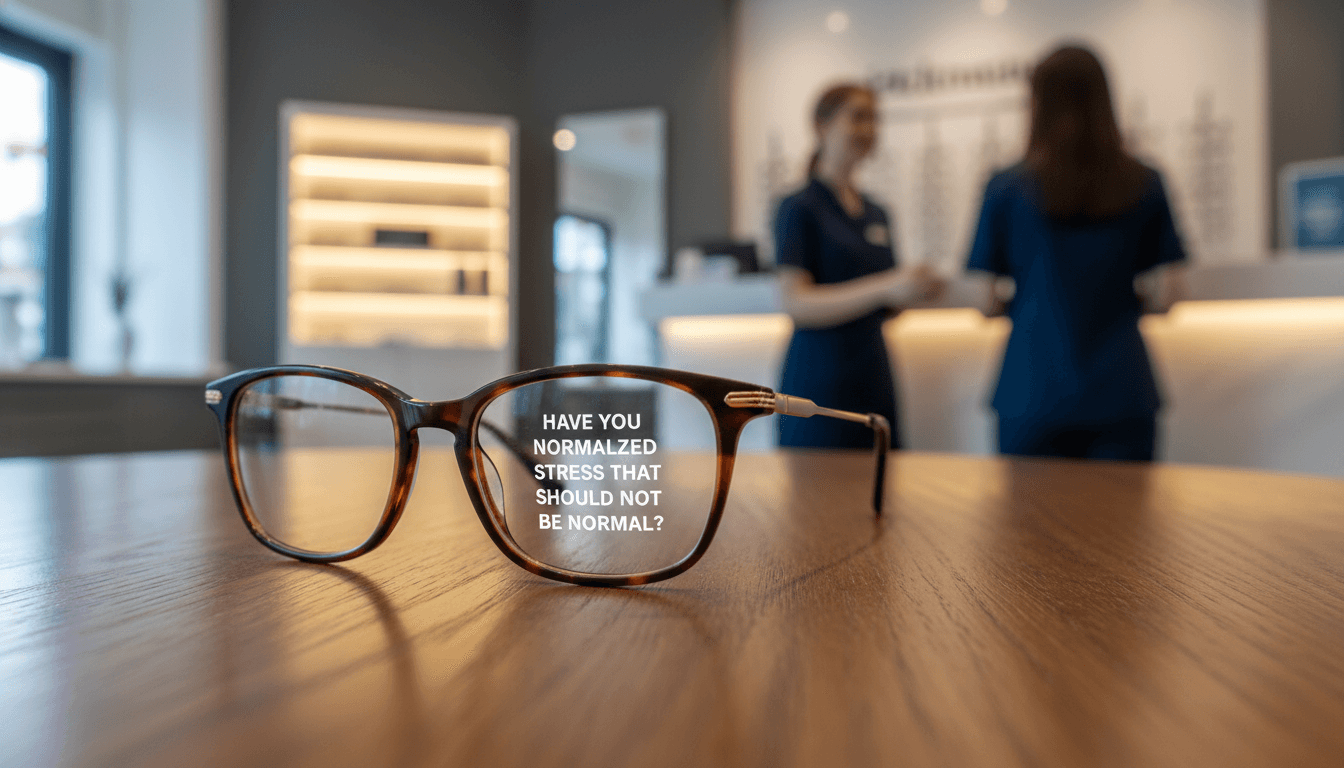
Most days don’t arrive shouting. They arrive full, already running close to the edge. The diary is tight, a couple of appointments have crept over, and there’s a patient waiting who didn’t expect to still be sitting there. Somewhere behind all that is the quiet awareness that commercial expectations haven’t disappeared just because the clinic is busy. None of this feels dramatic. It just feels like work. And that’s precisely the problem.
It’s worth saying early on that feeling stretched in this environment isn’t a personal weakness. This is a public-facing space where care, responsibility, and retail reality sit on top of each other all day long. Some pressure comes with that. Anyone who pretends otherwise isn’t being honest. The question is what happens when pressure stops being occasional and starts being assumed, when the body and mind adjust so well that you forget to notice the cost.
You might recognise the feeling of holding your breath without realising it. Not literally, but emotionally. The way you move from one patient to the next with no space in between, or how a concern raised late in the afternoon lands heavier than it should because there’s no margin left to absorb it. When did that start to feel normal rather than concerning?
It might be worth asking yourself when you first noticed that tightness at the end of the day and decided it was just part of the job. Was it during a period when clinics were regularly overrunning and everyone seemed to be in the same boat, or did it creep in more quietly, one rushed handover or awkward front desk conversation at a time?
Another question that can be uncomfortable is whether there are moments you now brace for without questioning why. For example, when a patient’s frustration spills over because they’ve been waiting longer than planned, do you catch yourself preparing for it as if it’s inevitable, rather than something that deserves attention and care in its own right?
There’s also the matter of what you’ve stopped talking about. Are there parts of the day that drain you more than others but never quite make it into conversation, perhaps because everyone else seems to manage, or because raising it feels like complaining? Silence can be a powerful normaliser.
And then there’s the question of what you tell yourself at the end of a hard day. Do you frame the stress as a temporary blip even when it’s been there for months, or as the price of doing the work properly, even when it’s starting to dull your sense of satisfaction?
None of these questions are about blame. They’re about noticing. Stress becomes most entrenched when it’s unnamed, when it sits so close to routine that it’s mistaken for professionalism. In optician’s practices, that can look like pride in keeping things moving no matter what, or in absorbing tension so patients don’t see it. That pride isn’t wrong, but it can quietly tip into something else.
There often comes a moment, sometimes small, that interrupts the pattern. It might be realising you’re unusually irritable over something minor, or feeling a flash of resentment when another late-running clinic is waved through as unavoidable. These moments don’t mean anything is broken. They can simply be signals that what’s been tolerated is asking to be re-examined.
If you wanted to take a step forward, even a small one, it might start with curiosity rather than change. What would it feel like to name one part of the day that reliably adds strain, without immediately justifying it or pushing it aside?
You might also wonder what standards you’re quietly holding yourself to that no one has explicitly asked for. Are there expectations you’ve internalised about pace, composure, or availability that could be questioned, even gently?
Another line of thought could be about boundaries in time rather than tasks. Is there a point in the day, perhaps when a patient concern arrives late or the diary slips again, where you could acknowledge the impact rather than powering through as if it doesn’t matter?
And finally, it may be worth considering who you allow yourself to be honest with. Is there someone in or around the practice with whom you could say, “This level of pressure doesn’t feel sustainable,” without it turning into a problem to fix or a weakness to defend?
Normalising stress is rarely a conscious choice. It’s usually the result of wanting to do a good job, day after day, in a system that doesn’t always leave room to pause. Noticing it doesn’t mean you’re failing. It means you’re paying attention.
If this question has stirred something, and you want to talk it through rather than sit with it alone, you’re welcome to reply. Sometimes saying it out loud is enough to stop something unhealthy from being mistaken for normal.
Where this could take you
Curious what the market looks like for you?
Build your perfect job in under two minutes - postcode in, salary bands, advertised and hidden-market vacancies out.
Build your perfect job